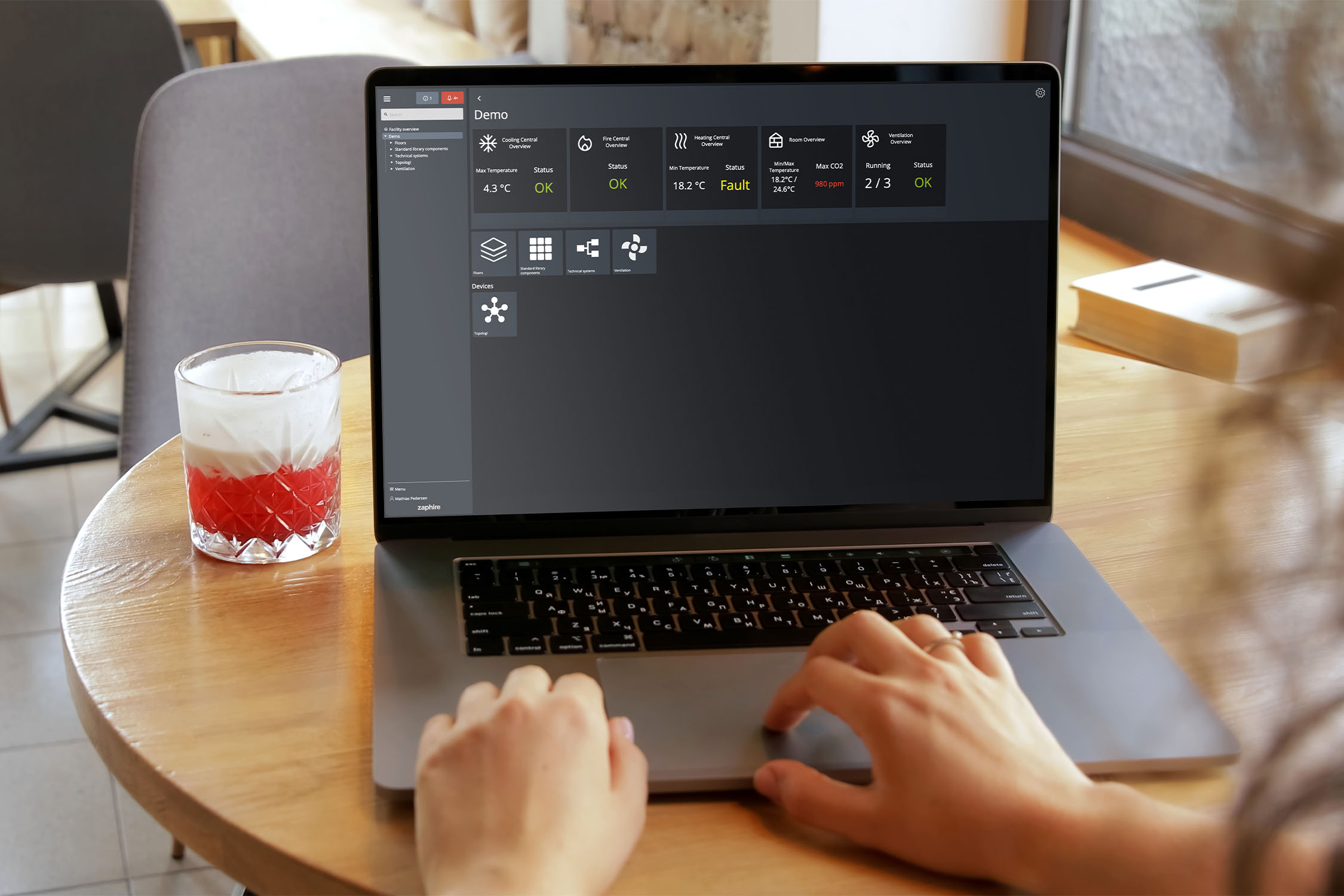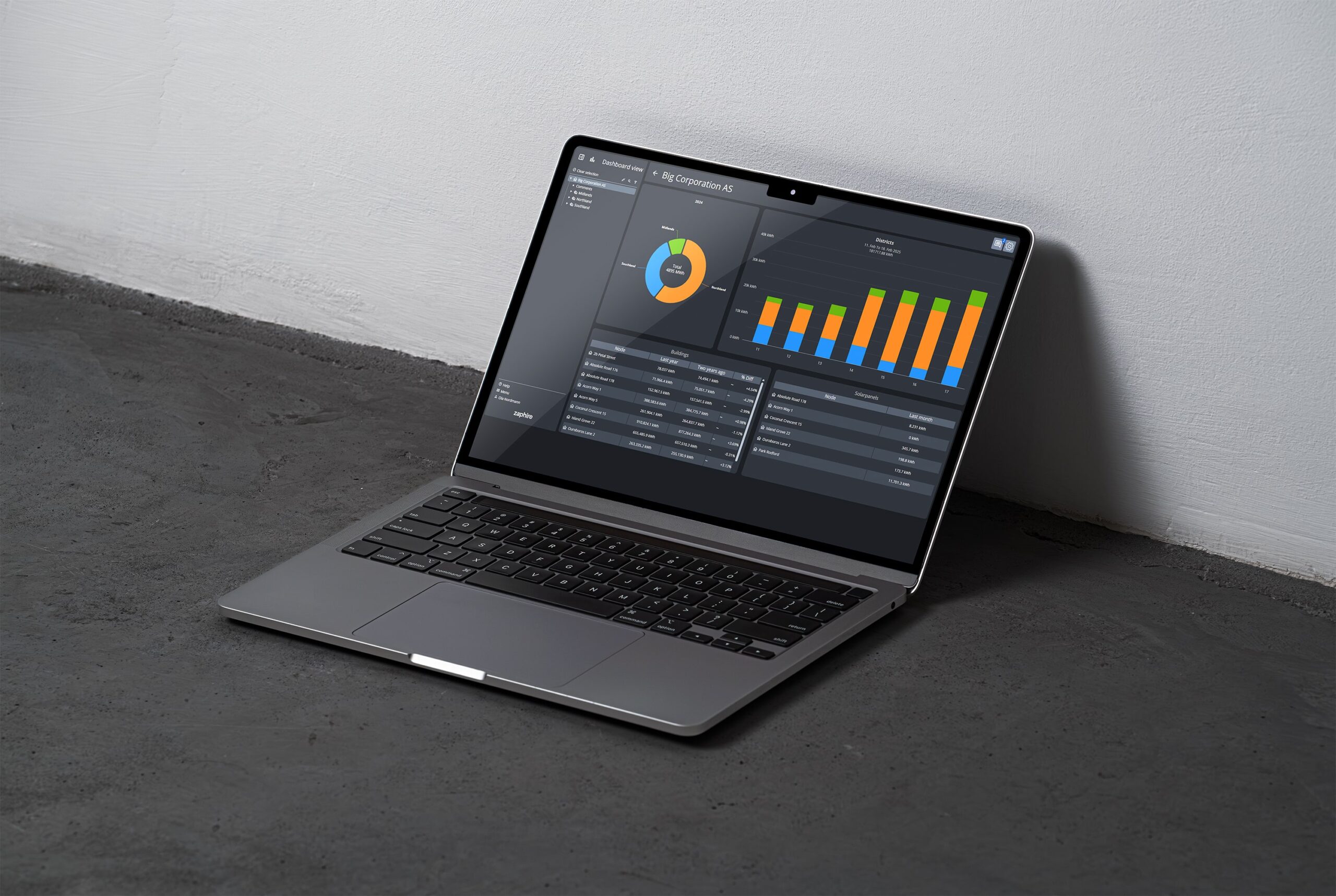
What Is Load Management in Commercial Buildings?
Load management in commercial buildings is about controlling when and how electrical loads are used so that total power demand is reduced or shifted to periods of lower load. The goal is to use energy more intelligently without compromising comfort or operations.
In practice, this means that technical installations such as ventilation, heating, cooling, and EV charging are adapted to the building’s actual needs and available grid capacity. For building owners and tenants, this provides better control over energy costs, while the building contributes to a more robust and efficient power grid.
In buildings with local energy production, such as solar panels or batteries, load management can also improve the utilization of self-generated electricity. By aligning energy consumption with production periods, the share of self-consumption can be increased while further reducing strain on the power grid.

Load Management and Demand Response - What’s the Difference?
The terms load management and demand response are often used interchangeably, but they describe different levels of the same phenomenon.
- Load management refers to the operational and technical control that takes place within the building itself.
- Demand response describes how flexible electricity consumption can be used as a resource in the power system, for example through markets or grid control mechanisms.
Simply put, load management is the tool, while demand response is the system and market mechanism. Effective demand response depends on good load management at the building level.
For commercial buildings, this means that load management is what enables participation in or response to demand response schemes. Without the technical ability to control and prioritize loads at the building level, the building cannot, in practice, offer flexibility to the power system. Good load management is therefore a prerequisite for commercial buildings to function as an active resource in the energy system.
How Does Load Management Work in Commercial Buildings?
Modern load management is based on real-time data, automation, and intelligent control systems. A central building management system (BMS) continuously collects information on energy consumption, power demand, and operating conditions, providing a comprehensive view of how energy is actually used. Based on this, the building can be controlled dynamically, both automatically and through predefined strategies.
Real-Time Data as a Basis for Decisions
Effective load management depends on access to the right data. The BMS receives information such as instantaneous power demand, historical energy consumption, temperatures and indoor climate conditions, as well as operating times and load patterns.
This makes it possible to identify power peaks, unnecessary energy use, and periods when loads can be reduced or shifted without being noticed by building users.
Power Control and Time-Based Energy Management
A core function of load management is controlling both how much power the building uses and when energy is consumed. Through the BMS, total power demand can be kept within defined limits while energy use is shifted to more favorable times.
In practice, this means that the system can automatically:
- throttle or postpone less critical loads
- prevent simultaneous operation of power-intensive systems
- reduce or avoid unnecessary power peaks
At the same time, energy use can be shifted in time, for example to periods with lower internal load or better available grid capacity. Typical measures include preheating, shifted cooling production, or scheduled EV charging outside peak-load periods. Loads can also be prioritized based on importance and need, for example by prioritizing comfort-critical systems first, followed by flexible loads, and finally the least critical ones.
This combination of power control and time-based management is particularly important for reducing costs related to demand charges in grid tariffs and for avoiding the need for costly capacity or grid upgrades.
Which Loads Can Be Managed in Commercial Buildings?
Commercial buildings typically have several electrical loads that are well suited for load management. What they have in common is that they can either be regulated in power, shifted in time, or temporarily reduced without compromising comfort, safety, or operations. The more loads included in the control strategy, the greater the flexibility and potential benefits.
Ventilation
Ventilation is often one of the largest energy loads in commercial buildings. Through load management, airflow rates and operating times can be adapted to actual demand, and ventilation systems can be temporarily reduced during periods of high load. Short-term adjustments typically have little or no noticeable impact on indoor climate, but can significantly reduce power demand.

Heating and Cooling
Heating and cooling have great potential for load management because the building itself acts as a thermal storage. Temperatures can be adjusted within defined comfort limits, and energy use can be shifted in time through preheating or precooling. This makes it possible to reduce power peaks without users experiencing reduced comfort.
Lighting
Lighting in commercial buildings is often already automatically controlled through dedicated lighting control systems, based on occupancy, daylight, and schedules. This makes lighting well suited for load management, often without the need for manual intervention.
Although lighting is often controlled outside the BMS, it can be integrated and coordinated through the BMS. This allows lighting to become part of holistic load management at the building level, interacting with ventilation, heating, cooling, and other loads. This kind of integration is often enabled through open protocols such as BACnet, Modbus, KNX, and OPC UA.
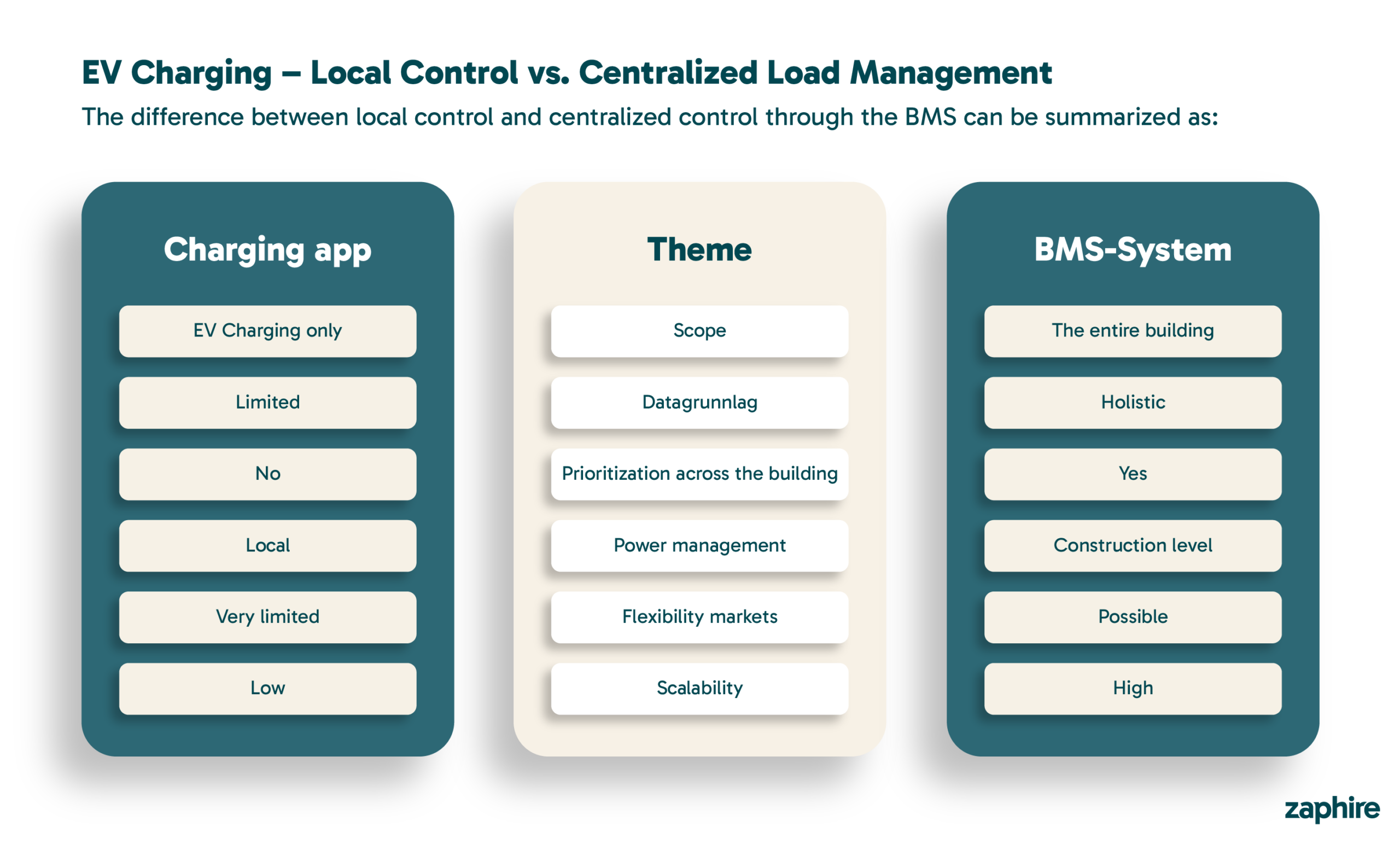
EV Charging - Local Control vs. Centralized Load Management
EV charging is becoming an increasingly important load in commercial buildings and is often among the most power-intensive. At the same time, charging is very well suited for load management, since charging power can usually be regulated or shifted in time without practical consequences for users.
In many buildings, EV charging load management is handled through dedicated charging apps or vendor-specific systems. This provides effective local control, ensuring that available capacity is distributed among charging points and that overload is avoided.
The greatest benefit, however, is achieved when EV charging is centrally controlled via the BMS, in coordination with other building loads. Charging power can then be prioritized up or down based on total power demand and the load from ventilation, heating, and cooling.
In this way, EV charging moves from being an isolated function to becoming an integrated part of the building’s overall load management, with better utilization of available power and greater potential for cost reductions. This also opens up for increased flexibility in BMS systems.
Load Management as Part of Smart and Sustainable Buildings
Load management is a key element in the development of smart and sustainable commercial buildings. By controlling energy use more intelligently, buildings contribute not only to lower costs but also to a more efficient, flexible, and robust energy system.
With increasing electrification and stricter energy efficiency requirements, the ability to use energy flexibly is becoming ever more important. This is closely linked to broader efforts around energy efficiency in commercial buildings and overall security in building automation.
Reduced Strain on the Power Grid
Through load management, commercial buildings can help smooth load on the power grid, especially during periods of high demand. When power peaks are reduced and energy use is shifted in time, the need for costly grid expansion is reduced.
This makes load management an important tool for handling increased energy demand without a corresponding increase in infrastructure.
Better Interaction with Renewable Energy
The production of renewable energy varies with weather and time of day. Load management makes it possible to adapt energy consumption to when energy is available. One example is increasing consumption when local solar production is high or reducing load when power availability is low. In this way, commercial buildings contribute to better utilization of renewable energy sources and lower system emissions.
Load Management in the Zaphire BMS
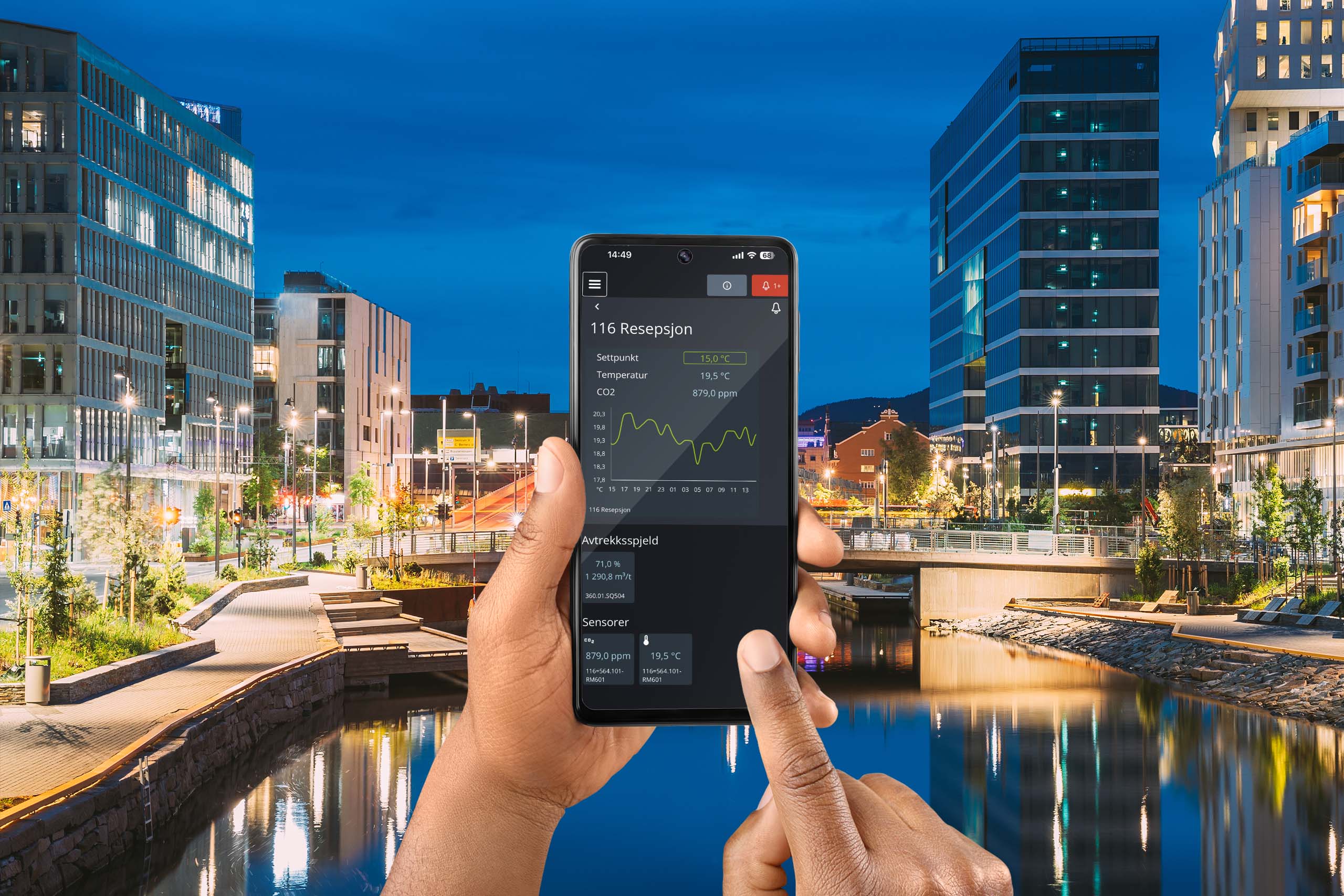
In the Zaphire BMS, load management is an integrated part of holistic building control. The solution is designed to provide full visibility into energy consumption and power demand, and to make it easy to control multiple loads in coordination. By centralizing control in the BMS, building owners and operations staff gain a single, shared decision-making basis for energy use, based on real-time data and actual operating conditions.
With Zaphire, you can efficiently control ventilation, heating, cooling, lighting, and EV charging within one unified framework. Load management is largely automated, based on defined strategies and continuously updated data. This makes it possible to:
- prioritize loads based on comfort and criticality
- limit total power demand at the building level
- reduce simultaneity between power-intensive systems
A key principle of the Zaphire BMS is scalability. The solution is designed to easily handle increased energy use over time, allowing you to add new buildings, zones, or components efficiently. This enables the building to adapt to new requirements and market opportunities without the need for extensive retrofits, including reuse of existing BMS infrastructure.